The Lab
Explore a synapse
The tiny junction where one neuron talks to the next. Spin it, click a part to see what it does, and hit Release to send neurotransmitter across the gap. You can also break any part to see what goes wrong, then repair it.
Building the synapse…
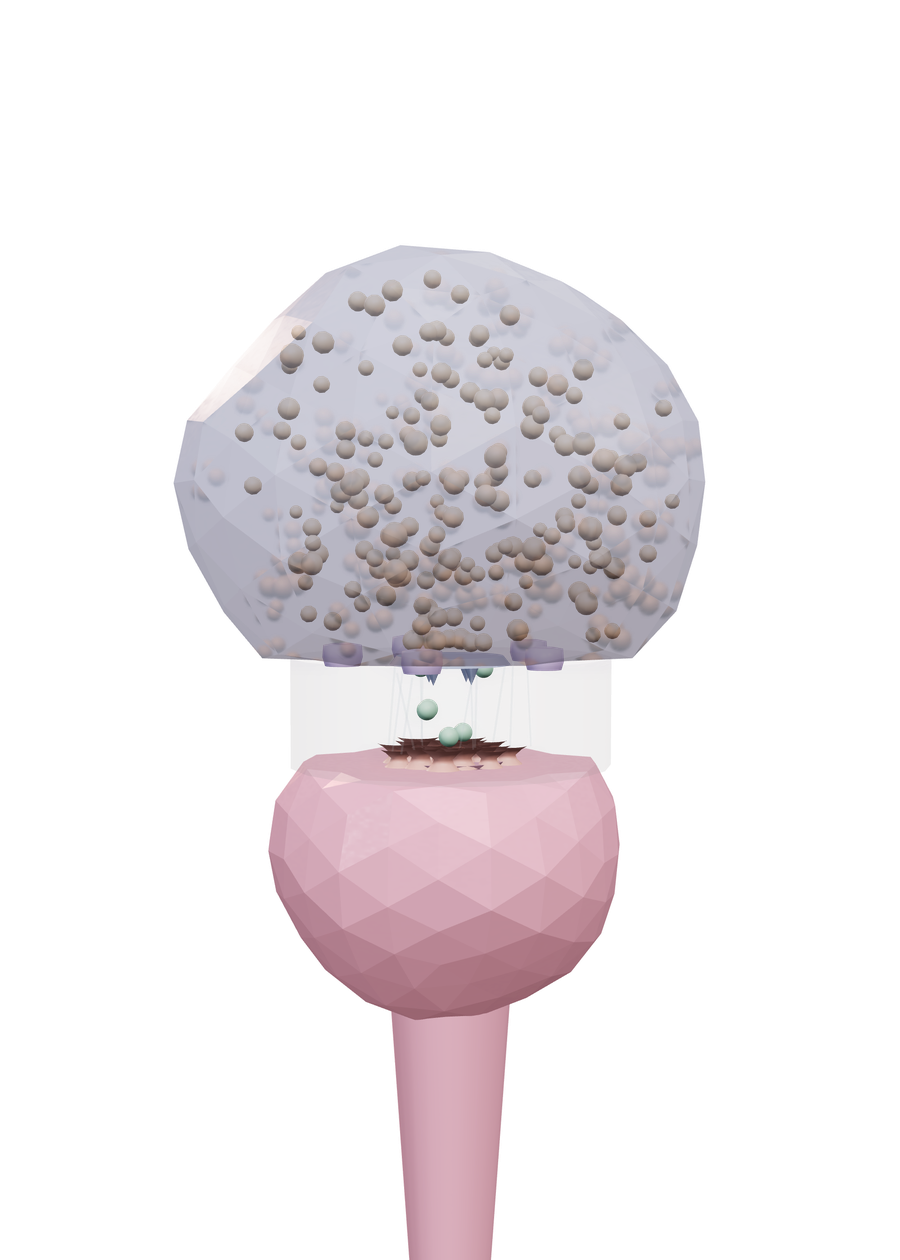
The interactive 3D couldn't load. Here's what each part does:
- Presynaptic terminal
- This is the very end of the sending neuron, the tip of its axon.
- Synaptic vesicles
- Vesicles are tiny bubble-like sacs packed with neurotransmitter and parked near the tip of the sending neuron.
- Neurotransmitter
- Neurotransmitters are the chemical messengers that actually carry the signal across the gap between two neurons.
- Synaptic cleft
- The synaptic cleft is the tiny gap between the two neurons, so narrow that the messenger crosses it almost instantly.
- Postsynaptic membrane
- This is the receiving surface of the next neuron, the part that catches the message.
- Receptors
- Receptors are proteins on the receiving neuron that grab the neurotransmitter as it arrives, each one shaped to fit a specific messenger like a lock and key.
- Reuptake transporters
- After a message is delivered, these pump-like proteins vacuum the leftover neurotransmitter out of the gap and haul it back into the sending neuron to be reused.
Drag to rotate · scroll to zoom · click a part
A stylized teaching model built by The Neuroscience Review. Distances are exaggerated so you can see inside. Descriptions written and sourced by us.