The Lab
Explore the brain
Spin it, zoom in, and click a region to see what it does, in clear language. Slide it apart to see the deep structures, turn on x-ray to see straight through the cortex, or damage any region to see the condition it causes and then repair it.
Loading the brain…
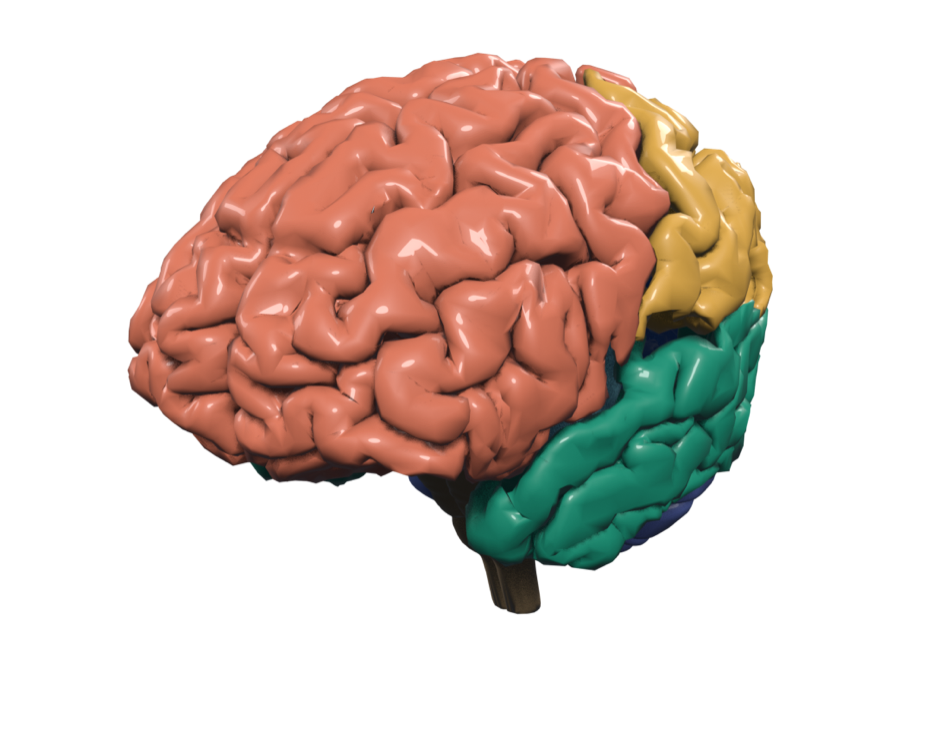
The interactive 3D couldn't load. Here's what each region does:
Cerebral cortex (outer surface)
- Frontal lobe
- The frontal lobe sits right behind your forehead and stretches back to a deep groove called the central sulcus.
- Parietal lobe
- The parietal lobe sits just behind the frontal lobe, across the central sulcus.
- Temporal lobe
- The temporal lobe sits low on each side of the brain, roughly behind your temples and ears.
- Occipital lobe
- The occipital lobe sits at the very back of your head and is almost entirely devoted to vision.
- Limbic lobe
- The limbic lobe isn't a bump you can spot from the outside.
Deep structures
- Cerebellum
- The cerebellum sits at the back of the brain, tucked underneath the two big hemispheres.
- Brainstem
- The brainstem is the stalk that connects your brain to your spinal cord, and it's built from three parts called the midbrain, pons, and medulla.
- Thalamus
- The thalamus is a pair of egg-shaped hubs sitting near the center of the brain.
- Hypothalamus
- The hypothalamus is a small region deep in the brain, sitting just below the thalamus.
- Basal ganglia
- The basal ganglia are a cluster of structures buried deep beneath the cortex.
- Hippocampus
- The hippocampus is a curved, seahorse-shaped structure in the brain's temporal lobe, and you have one on each side.
- Amygdala
- The amygdala is a pair of almond-shaped clusters deep in the temporal lobes, and its name comes from the Greek word for almond.
- Corpus callosum
- The corpus callosum is a thick band of roughly 200 million nerve fibers running across the middle of the brain.
- Ventricles
- The ventricles are four hollow, connected chambers deep inside the brain, filled with clear cerebrospinal fluid.
Drag to rotate · scroll to zoom · click a region
3D model: Z-Anatomy (Gauthier Kervyn) & BodyParts3D / DBCLS, licensed CC BY-SA 4.0. Descriptions written and sourced by The Neuroscience Review.