Dopamine doesn't do what you think it does.
The "pleasure chemical" framing is wrong in a specific, important way. And the popular misuse of the word has consequences.
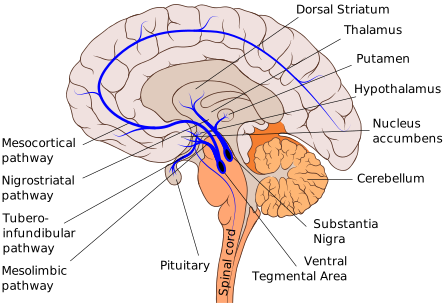
If you've spent any time on the internet, you've absorbed a particular story about dopamine. It goes like this. Dopamine is the brain's reward chemical. When you eat something delicious, scroll Instagram, take a drug, or accomplish a goal, your brain releases dopamine and you feel pleasure. Things that release large amounts of dopamine, like phones, sugar, and drugs of abuse, are addictive because they keep flooding the reward system. The solution, apparently, is a "dopamine detox."
Almost every part of that story is wrong, or at least seriously misleading. Here's what dopamine actually does, what the research has shown for thirty years, and why the slop version matters.
The basic picture
Dopamine is a neurotransmitter, one of the chemical signals neurons use to talk to each other. The neurons that release it are concentrated in two small structures deep in the midbrain, the substantia nigra and the ventral tegmental area. From there, their axons project widely into the rest of the brain, including the striatum, the prefrontal cortex, and the limbic system.
Dopamine is involved in many things, including movement (Parkinson's disease is essentially the death of dopamine neurons in the substantia nigra), executive function, hormone regulation, and, yes, reward. But the word "reward" is doing heavy lifting in that sentence, and unpacking it is where the popular story starts to fall apart.
The Schultz experiments
In the 1990s, the neuroscientist Wolfram Schultz and his collaborators ran a series of experiments on macaque monkeys that fundamentally changed how the field thought about dopamine. Their setup was simple. A monkey was given a reward, a drop of juice, at unpredictable intervals. Schultz recorded the activity of individual dopamine neurons during the experiment.
The naive prediction, if dopamine equals pleasure, would be that dopamine neurons fire when the juice arrives. They did. But that wasn't the only time they fired.
When the experimenters started preceding the juice with a predictable cue (a light or a tone), dopamine neurons stopped firing when the juice arrived and started firing when the cue appeared. The neurons had shifted to responding to the prediction of reward, not the reward itself.
More striking still. If the cue was presented and the juice was not delivered, dopamine activity dropped below baseline at the moment the juice should have arrived. The neurons were signaling not "pleasure" but something more like "this is better than I expected" or "this is worse than I expected."
This is now understood as a reward prediction error. Dopamine neurons aren't measuring how good something feels. They're measuring the gap between what you predicted would happen and what actually happened. Better than predicted, dopamine fires. Exactly as predicted, roughly baseline. Worse than predicted, activity dips.
Wanting vs. liking
A parallel line of research from Kent Berridge's lab at the University of Michigan pushed the picture even further. Berridge showed, in rats, that you can pharmacologically dissociate two things the casual "pleasure chemical" framing lumps together.
He called them wanting and liking. Wanting is the motivation to pursue a reward. Liking is the actual hedonic experience when you get it. Berridge's work showed that dopamine is required for wanting, but not for liking. Rats whose dopamine systems are destroyed won't seek out food. Left in front of a meal they won't eat it either, and will starve unless they're fed by hand. But put a drop of something sweet in their mouths and their facial reactions (a measurable index of hedonic response in rodents) stay completely normal. They've lost the wanting, not the liking.
In other words, dopamine isn't the pleasure itself. It's the motivation to chase what your brain predicts will be pleasurable. The pleasure itself (the "liking") seems to depend on different systems, involving opioid and endocannabinoid signaling.
Why this matters
Much of the popular pseudo-science about dopamine collapses once you get this distinction right.
"Dopamine detox" (the idea that you should fast from stimulating activities to "reset" your dopamine) is mostly nonsense, for two reasons. First, dopamine isn't a finite resource that depletes when you use it. It's a continuously produced signaling molecule. Second, even if there were such a thing as chronically "low dopamine," low dopamine doesn't sound like calm or focus. It sounds like Parkinson's disease.
"Dopamine hit," when used to describe an instant of pleasure from a phone notification, is at best a loose metaphor and at worst a clinical-sounding cover for what's really just everyday motivation and habit formation.
The framing matters because it pushes people toward the wrong interventions. If your problem is that you can't stop scrolling, the dopamine framing implies the solution is to deprive yourself until your dopamine "resets." A better framing (informed by what dopamine actually does) would put it differently. Scrolling has trained your brain to expect novel rewards, and to fire prediction signals in pursuit of them. The intervention isn't deprivation. It's substituting other activities that train your prediction system differently.
Wanting and liking run on different systems. Dopamine is the engine of the wanting.
What's still unknown
The reward-prediction-error story is well-supported, but it isn't the whole story. There's growing evidence that dopamine encodes more than just reward prediction. It may also encode prediction errors related to threat, novelty, and even certain kinds of cognitive surprise. Different populations of dopamine neurons may be doing somewhat different jobs. Even the wanting/liking distinction, while well-replicated in animals, has been harder to translate cleanly to human studies.
What's clear is that "dopamine equals pleasure" is a thirty-year-old caricature, and it survives mainly because it's easy to say and just plausible enough to feel true.
The takeaway
If you want a short, accurate replacement for the wrong version, dopamine is part of how your brain learns what to chase. It signals "this is worth pursuing" more than it signals "this feels good." Activities that train your brain to repeatedly expect novel rewards, like phones, slot machines, and certain drugs, recruit this system in ways your brain didn't evolve to handle.
That's still pop-level, but it's pop-level that's actually true, and the difference is worth caring about.
For another case of a big, loaded behavior turning out to have a specific address in the brain, see the breakdown of the aggression circuit in the mouse hypothalamus.